
Contact
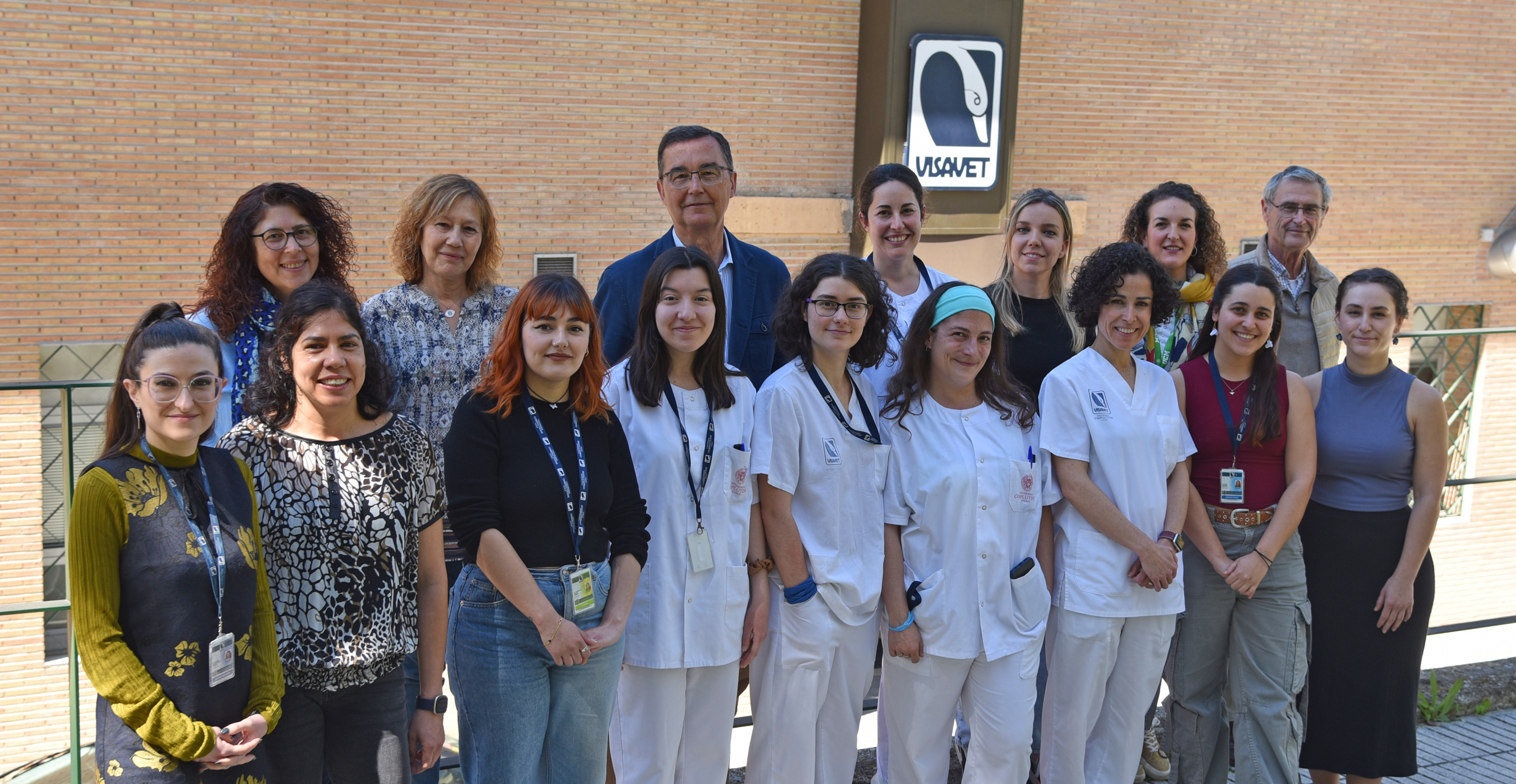
Microbial Identification and Characterisation Unit
VISAVET Health Surveillance Centre
Universidad Complutense
Av. Puerta de Hierro s/n. 28040 Madrid. Spain

e-mail:
Head office phone: (+34) 913 944 096
Laboratory phone: (+34) 913 943 975
This unit is focused on the study at the phenotypic, genomic and protein leves of pathogenic bacteria of veterinary interest. The main activities of the Unit are divided into three research lines that are closely related: clinical diagnosis (using phenotypic, molecular and chemotaxonomic methods, the molecular characterization of pathogenic bacteria of relevant clinical significance for epidemiological purposes and description of new bacterial species (bacterial taxonomy). The molecular characterization allows tracing epidemiological links between strains associated with outbreaks of disease, global epidemiological studies, monitoring programs, etc. Studies of bacterial taxonomy not only allow the description of new species but also allow, for example, the association of different pathogens with atypical clinical processes. Additionally, this unit integrates the Mass Spectrometry VISAVET- Bruker Platform enabling developing proteomics research studies in the field of microbiology and molecular histology.
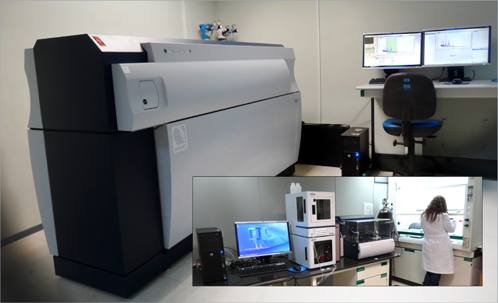
This platform was acquired in the 2011 call of the Equipment Acquisition and Scientific-Technical Infrastructure Adequacy (CAIMON) of Campus MONCLOA and enable the constitution of a service to enhance the research on campus.
The VISAVET-BRUKER service is made within the framework of a collaboration agreement between the Complutense University and Bruker Daltonik GMBH.
Application for identification and classification of bacteria and fungi. The identification is based on the comparison of the spectral fingerprints of the microorganism with those existing in the database (composed for more than 4000 entries). The technique is an accurate, simple, fast and reliable alternative for the identification of bacteria with traditional methods.
 MALDI BIOTYPER analysis services (coming soon)
Application of MALDI TOF MS for the two dimensional acquisition of mass spectra from fresh tissue section. Image MALDI is ideal for the identification of protein markers and other small molecules in tissue sections.
IMAGE MALDI analysis services (coming soon)
System allowing the identification of proteins primarily by determining its peptide fingerprint. Enables Proteomics studies.
Servicios de An?isis por LC-MALDI (coming soon)
Investigation

Research lines:

Next scientific publications:
- Kalalizi E., Flores L., Perez-Sancho M., Perello A., Herranz-Benito C., Herrera L., Romero B., Kaleme P., Garcia-Seco T., Kujirakwinja D., Kalonji A., Kashongwe Z., Birembano-Machara F., Baganda D., Nkonzi P., Velez del Burgo I., Le Gal F., de la Fuente J., Dominguez L. and Gortazar C.. Non-invasive environmental DNA sampling reveals tuberculosis risks at the human - Great Ape Interface in Africa. Emerging microbes and infections. In Press (A)
Last scientific publications:
- Sánchez-Morales L., Zamora L., Perez-Sancho M., Garcia-Seco T., Moreno I., Perez-Domingo A., Diaz-de Frutos M., Ciordia S., Buendia A., Risalde MA., Dominguez M. and Dominguez L.. Evaluation of trained immunity as a potential strategy for a universal Streptococcus suis vaccine using immunogenic proteins in a murine model. BMC Veterinary Research, 22(1):66. 2026. (A)
- Marin-Rojo A., Herrero-Garcia G., Herranz-Benito C., Barroso P., Relimpio D., Garcia-Seco T., Perello A., Diez-Guerrier A., Pozo P., Balseiro A., Dominguez L., Perez-Sancho M. and Gortazar C.. Wildlife risk mitigation protocols reduce risk species visits and pathogen marker detection in open-air farms. Veterinary Research, 56(1):237. 2025. (A)
- Vela AI., Serna C., Ugarte-Ruiz M., Buendia A., Casamayor A., Calderón-Bernal JM., Dominguez L., Cid D. and Fernandez-Garayzabal JF.. Antibiotic Resistance to Critically Important Antimicrobials and Virulence Genes in Enterococcus faecalis Strains Isolated from Eurasian Griffon Vultures (Gyps fulvus) and Their Association with Mobile Genetic Elements. Veterinary sciences, 12(11):1083. 2025. (A)
- Shahin K., Abdel-Glil M., Burcin Saticioglu I., Duman M., Altun S., Colussi S., Esposito G., Acutis PL., Marino P., Spondler B., Altinok I., Kotzamanidis C., Vela AI., Soto E., Gomes-Leal CA., Ajmi N. and Aoki S.. Diving Into the Depths: Unveiling the Main Etiologies of Piscine Lactococcosis With a Novel Multiplex qPCR Assay. Journal of Fish Diseases, 48(11):e14147. 2025. (A)
- Sánchez-Morales L., Porras N., Perez-Domingo A., Perez-Sancho M., Garcia-Seco T., Diaz-de Frutos M., Buendia A., Moreno I., Zamora L., Balseiro A., Risalde MA., Rodriguez-Bertos A., Gortazar C., Dominguez M. and Dominguez L.. The impact of mycobacteria-induced trained immunity on SARS-CoV-2 vaccine responses. Frontiers in immunology, 16. 2025. (A)

Last PhD thesis supervised:
- Coral Polo Vaquero. New approaches in the control of infectious fertility problems in extensive cattle. 2023. (Doctorado Industrial)
- Leydis Zamora Morales. Estudio taxonómico de bacterias relacionadas con el Síndrome del Alevín de la trucha. 2015. (Premio Laboratorios Ovejero)
- Verónica Sánchez del Rey. Estructura y diversidad de la población de Streptococcus suis presente en el ganado porcino, jabalí y conejo silvestre. 2015.
- Monica Aguado Urda. Caracterización y análisis funcional del genoma de Lactococcus garvieae. 2014.
- Verena Blume Serrano. Molecular characterization of Streptococcus suis (serotypes 2 and 9) isolated from swine in Spain. 2010.
Outreach

Last outreach publications:
- Sánchez-Morales L., Garcia-Seco T., Diez-Guerrier A., Dominguez L. and Perez-Sancho M.. Del estímulo al recuerdo: cómo se entrena la inmunidad innata. Ganadería, Agricola. 2026.
- Sánchez-Morales L.. ¡Invasión silenciosa! Cómo las especies exóticas invasoras están cambiando nuestros ecosistemas. Unidad de Divulgación Científica y Transferencia, Universidad Complutense. 2024.
- Perez-Sancho M., Garcia-Seco T., Sánchez-Morales L., Moreno I., Dominguez M., Goyache J. and Dominguez L.. Trained immunity and mycobacteria: towards the future of global health. Anales de la Real Academia de Doctores de España, 9(4):843-862, Real Academia de Doctores de España. 2024.
- Perez-Sancho M., Vela AI., Garcia-Seco T., Gottschalk M., Dominguez L. and Fernandez-Garayzabal JF.. Assessment of MALDI-TOF MS as alternative tool for Streptococcus suis identification. Applications of STEM (Science, Technology, Engineering and Mathematics) tools in microbiology of infectious diseases. Ed. 1. 113-118, Frontiers. 2017.
- Bezos J., Cots M. and Valls JL.. La Bronquitis Infecciosa Aviar. Merial Laboratorios S.A.. 2016.

Last communications:
- Sánchez-Morales L.. Trained immunity: understanding and investigating its role in preventive animal health strategies. Seminarios VISAVET 2026. 2026. (Oral communication)
- Fernandez-Manzano A., Diez-Guerrier A., Garcia-Seco T., Sánchez-Morales L., Perez-Domingo A., Mareque P., Casamayor A., Cruz F., Dominguez L. and Perez-Sancho M.. Explorando alternativas in vitro al desafío experimental con Streptococcus suis en lechones en estudios sobre inmunidad entrenada. XVIII Congreso Nacional SECAL. 2025. (Oral communication)
- Perez-Sancho M.. Identificación y caracterización microbiana mediante espectrometría de masas. Centro VISAVET-UCM: cómo se trabaja en un laboratorio de alta seguridad biológica. XXV Semana de la Ciencia Madri+d. 2025. (Oral communication)
- Garcia-Seco T., Herranz Benito C., Barcena C., Diez de Tejada P., Diaz R., Giron EC., Benito G., Alvarez J. and Perez-Sancho M.. Avances en la vigilancia ambiental de Coxiella burnetii en granjas de pequeños rumiantes. XXVIII Simposio Nacional AVEDILA. 2025. (Oral communication)
- Garcia-Seco T., Franco L., Sánchez-Morales L., Perez-Domingo A., Cruz F., Juste R., Agirregomoskorta I., Ceron JJ. and Perez-Sancho M.. Explorando la utilidad de marcadores de estrés oxidativo en ensayos de evaluación de la inmunidad entrenada orientada en modelo porcino. XXVIII Simposio Nacional AVEDILA. 2025. (Poster communication)